
Alesia Mickle Moldavan, Ph.D. is an Associate Professor of Elementary Mathematics and Science Education in the College of Education at Georgia Southern University. She received her BSEd in Mathematics Education at the University of Georgia, her MEd in Mathematics Education at Georgia State University, and her Ph.D. Teaching and Learning in Mathematics Education at Georgia State University. She specializes in teaching mathematics and science methods courses to both preservice and in-service teachers. With a background that includes teaching in diverse Title I secondary schools in Georgia and facilitating STEM enrichment programs at the elementary level, Alesia brings a wealth of practical and pedagogical experience to her role. Her teaching cultivates meaningful learning experiences by integrating culturally responsive strategies and preparing teachers to identify students' strengths and areas for growth, nurture positive STEM identities, and become ethical advocates and change agents for all learners. Her research interests center on equitable and culturally responsive teaching practices, as well as the integration of digital technology in teacher education to enhance accessibility and inclusivity. Rooted in a commitment to social justice, her work examines how systemic inequities affect educational outcomes and explores ways to disrupt inequitable narratives. Her recent scholarship emphasizes the development and implementation of innovative curricula and instructional practices in teacher preparation programs that foster cultural awareness, critically engage with issues of equity, and promote STEM justice-oriented advocacy. By empowering teachers with the tools to recognize and address social injustices in educational settings, her research supports the cultivation of socially conscious teachers who are equipped to enact change within and beyond the classroom. Bailey Nafziger, Ed.D. is an Assistant Professor of Elementary Science Education in the College of Education at Georgia Southern University. She received her BS in elementary education from the College of St. Scholastica in Duluth, Minnesota, her master's in science education from Northern Arizona University, and her educational doctorate from the University of North Dakota. Bailey spent her first decade in education working as a middle school science teacher and an elementary gifted specialist in southern Arizona. Along with regular teaching responsibilities, Bailey took on teacher-leadership roles including serving as an instructional coach, mentoring new teachers, leading professional learning communities, as well as designing and facilitating professional development in both science and gifted education at a district and state level. She also dedicated time to her students working as a soccer coach, Student Council advisor, and being an advisor for other various student-led initiatives. Currently, Bailey teaches elementary science education methods at both the undergraduate and graduate levels. Her classes have a strong theme of asset-based instruction and differentiating to elevate the strengths of each student. Her recent scholarship centers on overlaps between science education, gifted education, and culturally responsive teaching. Her goal is to empower teachers to engage in social justice work in their classroom while modeling the process to and for their students. Bailey has truly fallen in love with teaching and maintains the goal of preparing teachers for the dedication, passion, and perseverance necessary to succeed in the field today.
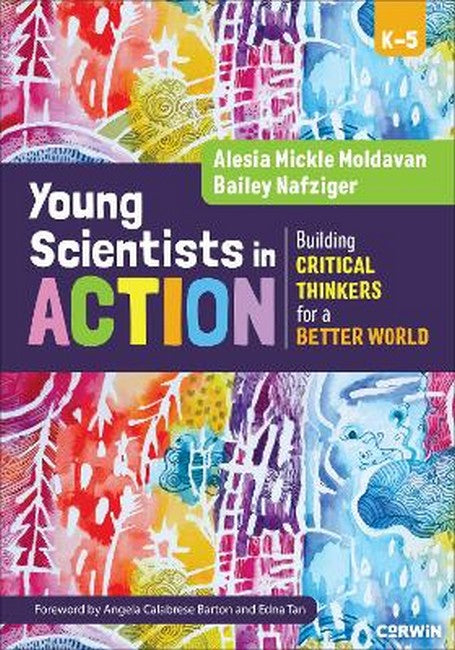

Empower every student to make positive change through science Elementary teachers face the immense challenge of lesson planning across multiple subjects, often under the weight of standardized testing that prioritizes reading and math. Too often, this leaves science overlooked-even though it holds the power to enrich literacy, numeracy, and, more importantly, students' understanding of the world. With the right support, science instruction can move beyond worksheets and standards checklists to become a subject where curiosity and critical thinking drive learning and students see connections to their own lives. This resource empowers educators to reclaim science as a space for relevance, meaning, and impact where it matters most-in the classroom. In Young Scientists in Action, authors Alesia Mickle Moldavan and Bailey Nafziger provide educators with the tools to transform elementary science classrooms into dynamic spaces where students critically engage with real-world issues. Using phenomena-based and community-focused approaches, this resource equips educators with practical strategies and ready-to-use lesson and unit plans that foster critical thinking and agency. By transforming science into both an academic pursuit and a catalyst for social change, the authors ignite purpose and engagement in the classroom. With a focus on actionable solutions for today's most pressing challenges, this book helps educators leverage science to inspire empathy, critical thinking, and community change in young learners by providing An Elicit-Investigate-Interrogate-Act Framework designed to guide educators through four key phases of instruction (Elicit, Investigate, Interrogate, and Act) that foster critical connections between science concepts and societal issues Lesson and Unit Plans that are interdisciplinary and ready to implement, and address real-world challenges such as environmental sustainability and accessibility for all learners Teacher Reflection Tools that include prompts, teaching manifestos, and strategies for small steps for big impact Connections with Standards like NGSS and enriched with practical advocacy strategies, providing a strong foundation for aligning instruction with authentic science practices that inspire students to envision and create a better future. Offering real-life examples, practical strategies, and evidence-based insights, Young Scientists in Action paves the way for educators to create classrooms where all students see themselves as scientists and advocates for change.
Foreword Preface Acknowledgments About the Authors Introduction Why This Book? Our Lenses and Beliefs Framing This Book My Adaptation and Why Motivator: Alesia Mickle Moldavan's Lens Looking Back to Move Forward With My Why: Bailey Nafziger's Lens A Collective Partnership The Book's Audience The Book's Organization Your Teaching Manifesto Part 1: Using Science to Solve Problems: Where Do We Begin? Chapter 1: Connecting Minds and Hearts Through Critical Thinking and Engagement in Science Building Critical Thinkers Empathy in Science Science as a Human and Social Endeavor Tracing Pedagogical Approaches Illuminating Students' Assets and Communities Using Science to Explore Fairness Understanding Our World and Each Other Representation Matters Mirrors, Windows, and Sliding Glass Doors Science as a Tool for Advocacy Connecting Initiatives in Science Education Reform and Standards to Equity Equity in the Context of NSTA and NGSS Integrating Standards for Fairness and Agency Chapter Summary Reflection Questions Chapter 2: Bringing Purpose and Action to Science How We Do (and Don't Do) Science Science Is a Way of Knowing Scientific Knowledge Assumes an Order of Consistency in Natural Systems Scientific Models, Laws, Mechanisms, and Theories Explain Natural Phenomena What Are Scientific Laws? What Are Scientific Theories? Scientific Knowledge Is Open to Revision in Light of New Evidence What Counts as Science? Who Gets to Do Science? Alternative Science Epistemologies The Value of Community Chapter Summary Reflection Questions Part 2: Designing and Implementing Science Lessons for Critical Thinking and Action Chapter 3: Planning Lessons That Matter and Foster Change Learning About Students Diversity as an Asset Sustaining an Inclusive Environment Establishing Classroom Norms A Framework for Social Justice Science Lessons The Elicit Phase Finding the Phenomena Types of Phenomena Where to Find Sociocultural-Informed Phenomena The Investigate Phase Planning for the Investigate Phase Three-Dimensional Science Teaching Instructional Considerations Focusing on Safety Collaborative Student Groups The Interrogate Phase Structuring Classroom Debates for Critical Thinking Guided Discussion With Claim-Evidence-Reasoning The Act Phase What Does Taking Action Look Like? How Teachers Can Support Student Action Using an Act Menu to Make a Difference Chapter Summary Reflection Questions Chapter 4: Unit Plans for Critical Thinking and Action Units in This Chapter Unit Plan 4.1: Water Negotiators Student Page: ELICIT: Water Negotiators Student Page: INVESTIGATE: Water Negotiators Student Page: INTERROGATE: Water Negotiators Student Page: ACT: Water Negotiators Teacher Page: INVESTIGATE: Water Negotiators Teacher Page: INTERROGATE: Water Negotiators' Roles Unit Plan 4.2: Diaper Deserts Student Page: ELICIT: Diaper Deserts Student Page: INVESTIGATE: Diaper Deserts Student Page: INTERROGATE: Diaper Deserts Student Page: ACT: Diaper Deserts Unit Plan 4.3: Honorable Harvest Student Page: ELICIT: Honorable Harvest Student Page: INVESTIGATE: Honorable Harvest Student Page: INTERROGATE: Honorable Harvest Student Page: ACT: Honorable Harvest Teacher Page: Mushroom Life Cycle Card Sort Teacher Page: General Unit Template Chapter Summary Reflection Questions Chapter 5: Grab-and-Go Lessons Lesson 5.1: Accessibility: Inclined Planes Lesson 5.2: Politics and Plastics Lesson 5.3: Invasive Carp Lesson 5.4: Fossil Fuels and Nonrenewable Energy Chapter Summary Reflection Questions Part 3: Looking Ahead and Taking Action Chapter 6: Navigating Today's Classroom with Purpose Knowing Your Purpose, Priorities, and Professional Responsibilities Finding Your People and Sphere of Influence Curating Patience for Growth Opportunities Keeping a Journal to Chronicle Progress Encouraging Growth Mindset Holding on to Hope Chapter Summary Reflection Questions Chapter 7: Your Call to Action Taking Action in Your Context Revisiting Your Teaching Manifesto Chapter Summary Reflection Questions References Index